

How EMG Testing for Repetitive Strain Injuries Will Pinpoint the Cause of Your Client’s Musculoskeletal Pain
Do you want to know how effective EMG testing for repetitive strain injuries can be? Consider Frank’s story:
Frank, 41, has worked on a factory assembly line since graduating high school. Although he’s never suffered any significant injuries or accidents on the factory floor, he recently noticed a persistent, burning pain in his elbow.
While he could ignore it at first, the pain only worsened. His elbow pain radiated down to his wrist, especially at night–making it hard for him to get the rest he needed for a hard day on the job. It wasn’t long before he struggled to even move his elbow at all, and he started to notice swelling in the area, too.
It was clear to Frank that he had injured himself. But how? Nothing unusual had happened to him while he was on the assembly line, nor had the pain developed after twisting his arm in an awkward position or lifting something heavy.
As it turned out, Frank had developed tennis elbow–a common name for tendinopathy of the elbow joint. Tennis elbow is a classic example of a repetitive strain injury (RSI). An RSI occurs not due to a major accident but because of repeated microtrauma over time–such as Frank’s repeated arm-stretching motion after 23 years on the factory floor.
Repetitive strain injuries incurred at work are eligible for worker’s compensation claims but can be difficult to prove. One tool in your toolbox is EMG testing, which measures electrical activity in an injured muscle. EMG testing for repetitive strain injuries, along with a comprehensive physical exam, can provide the evidence you need to craft a compelling claim for your clients with RSIs.
Integrity Diagnostics specializes in EMG and NCS testing services. We offer easy scheduling and fast turnaround times so you and your clients aren’t stuck waiting for weeks to move forward. Contact our SAVANNAH clinic today to get started!
Common Workplace-Related Repetitive Strain Injuries
Whether your client works in an office or a construction site, there are certain movements they perform day in and day out. Over time, these movements will strain the muscles, tendons, ligaments, and bones, leading to a repetitive strain injury.
There are many different types of repetitive strain injuries, and they can affect several different parts of the body–it all depends on the nature of your client’s work. However, here are some of the most common workplace-related RSIs to watch out for:
- Carpal tunnel syndrome affects the hands and wrists. While we often associate it with typing (and for good reason), any repetitive finger use can cause the condition.
- Tendinopathy refers to any injury to the tendons, including strains/tears and inflammation. Many different types of workers risk developing tendinopathy in their shoulders, hands, and elbows.
- Back strain is one of many potential causes of lower back pain and can result from prolonged sitting or incorrect form while lifting.
Another thing to consider is the type of work your client is doing. Certain tasks are more likely to cause repetitive strain injuries. As a general rule, the following types of movements can lead to RSIs:
- Small, frequent movements (such as typing or using gardening tools)
- Vigorous, forceful movements (such as using a jackhammer or lifting heavy objects)
- A lack of movement (such as sitting at a desk for prolonged periods)
Understanding the nature of your client’s work can help you and their doctor determine if a repetitive strain injury is at fault. So can diagnostic testing at Integrity Diagnostics.
The Role of EMG Testing in Diagnosing Repetitive Strain Injuries
In most cases, doctors diagnose RSIs through observation and movement screens. But when crafting a worker’s comp claim, you often want to reinforce that diagnosis with hard data.
EMG testing can provide that data. An EMG test involves measuring electrical activity in an affected muscle, which shows whether or not the muscles are responding to nerve signals the way they should. If they aren’t, it can be a sign of damage from a repetitive strain injury.
One of the big benefits of EMG testing for worker’s compensation is that they’re quick and easy. The test only takes about 30 minutes (60-90 minutes if we decide to perform an NCS, or nerve conduction study, as well) and requires minimum preparation for your client.
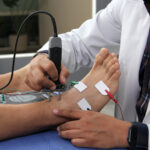
During the EMG test, one of our diagnostic experts will apply an electrode to the affected muscle. We’ll ask your client to contract and relax the muscle as our machine records all data. This process allows us to do the following:
- Identify the cause of your patient’s symptoms (including ruling out illnesses and other disorders)
- Identify the exact location of the RSI
- Evaluate the extent of the injury’s damage
- Assess an injury’s progression or regression
Once the testing is complete, our team of experts will work to prepare your client’s full report, which includes all data from the test, our interpretations of the data, and notes from a physical examination we might have performed. We know you need this information as soon as possible, so we always endeavor to have reports sent to you and your client’s doctor within 24 hours.
Get The Information You Need for Comprehensive, Effective Claims
Repetitive strain injuries are one of the most common types of workplace injuries. But due to the way they develop over time, filing a claim on one can prove challenging. Fortunately, an EMG test from Integrity Diagnostics will give you the evidence you need.
If one of your clients needs to file a worker’s compensation claim on a repetitive strain injury, refer them to our SAVANNAH clinic. We’ll complete the tests quickly and accurately so you can both proceed without stress.


Leave a Reply